One key for many locks — Qianhui Yu

Intelligences

Exhibition directory,
Season 1: Intelligences

You’ve arrived at the directory page for Intelligences, the first exhibition at the AI.Exchange, a public space in King’s Cross, London, funded by Google DeepMind. It lists every theme and exhibit.

You might be here because you scanned a QR code in the gallery to learn more about something that intrigued you. Or you’re somewhere else entirely, getting a taste of the exhibition from afar. Either way, welcome.

Each directory entry sits under one of the exhibition’s five themes, and opens with the words on the large label beside the exhibit in the gallery. Then, under Go deeper, you’ll find a handful of links to the science, the artists and the thinking behind those words – mostly short articles and videos.

Have a wander.

Bring yours, discover others,
explore what comes next.

Right now, humans are trying to build a new kind of artificial intelligence. A machine that could learn anything you can, then keep going.

It’s called artificial general intelligence (AGI). It would reason at least as well as a skilled person, across almost any kind of thinking. But at machine speed, and machine scale.

A scientist could use AGI to think through a lifetime’s worth of ideas in a day. But something that powerful might change the world more than anyone intends.

AI means “chatbot” to many, but that’s just its most visible aspect. Behind the scenes, specialist AI tools of every variety are now transforming science, technology and healthcare.

There’s already one generalist: you. You can learn languages, cooking, algebra, jokes. That flexible intelligence built everything around you. AGI would be the first machine generalist.

Its builders got this far by studying the kinds of intelligences that already exist. In humans like you, and in other creatures nothing like you.

The closer you look, the bigger the questions get. What is intelligence, anyway? Whose idea of intelligence gets built into the machines? And who would we want to be, in a world with intelligences like these?

What is intelligence, anyway?

Whose idea of intelligence
gets built into the machines?

And who would we want to be, in a world with intelligences like these?

Go deeper

Here’s a psychologist on what intelligence is (as far as anyone can agree) and the chair of Google DeepMind, Demis Hassabis, on where artificial intelligence is heading, and the AI tool that won him a share of the 2024 Nobel Prize in Chemistry.

  • Encyclopaedia entry, Britannica

    What is human intelligence? (opens in a new tab)

  • Essay, DeepMind Institute, 2026

    A framework for frontier AI and the dawning of a new age (opens in a new tab)

  • Article, nobelprize.org, 2024

    How AlphaFold cracked the protein problem (opens in a new tab)

1. The greatest machine never built

Your brain’s amazing. It can learn almost anything. But it reads slowly, writes slower, and can consider only a handful of things at once. It can’t copy your thinking perfectly into anyone else’s head, either.

Artificial general intelligence (AGI) could learn almost anything, without those constraints. It would tap into the work of millions of lifetimes, considering endless variables.

That multiplying power could help crack the problems stumping us. Doctors finding cures for “incurable” diseases. Engineers pulling CO2 out of the sky faster than we put it there. But nobody’s been able to build an AGI yet.

AI is already changing the world. AGI would be far more powerful. Benefits nobody’s thought to hope for. Risks nobody’s anticipated.

How do you feel about this future?

Go deeper

Here’s what one specialist AI tool is already doing for science, why others think artificial general intelligence (AGI) is further in the future than its builders claim, and what the people trying to build it hope and fear.

One key for many locks

All of the animation in One key for many locks was hand drawn by human animators. It contains no AI-generated content whatsoever.

Big, complex problems are like locked doors. Fixing the climate. Beating cancer. Storing enough renewable energy.

Artificial general intelligence (AGI) would build on human knowledge, tirelessly testing millions of ideas. It could help us find the keys.

But big solutions can have unintended consequences. Plastic was a miracle material. Now it’s a worldwide pollutant.

So what should people apply AGI to first, who gets to use it, and how should it be developed responsibly?

Go deeper

Here’s a United Nations report on why AI may widen inequality between countries, an example of the potential downside of revolutionary inventions, and the case for artificial general intelligence (AGI) from three of the leaders trying to build it.

  • Report summary, United Nations Development Programme, 2025

    The Next Great Divergence: why AI may widen inequality between countries (opens in a new tab)
  • Article, Smithsonian, 2022

    Microplastics detected in human blood (opens in a new tab)
  • Essay, DeepMind Institute, 2026

    What might a future with AGI look like? (opens in a new tab)

A Catalogue of Exceptions

Anna Ridler

These organisms are misfits. In 1668, John Wilkins tried sorting all life into tidy categories. An impossible dream, it turned out. Is coral a mineral? Is fungus a plant? The exceptions piled up.

Artist Anna Ridler embraced them. She gave Wilkins’ descriptions to AI image generators, old and new, spanning nearly a decade of the technology. The earlier generators conjured strange creatures. More recent generators smoothed the strangeness away. Can you classify the creatures in her collages?

Wilkins dreamed of cataloguing everything. AI’s builders dream of machines that make sense of everything. Another impossible dream, perhaps. But finding the exceptions helps us rethink how we sort, name and know the world.

Go deeper

Here’s the artist on why she made the collages, the Oxford show the project grew out of, and a look at the ambitious 17th-century scheme that started it all.

  • Artist’s website

    A Catalogue of Exceptions, in the artist’s words (opens in a new tab)
  • Exhibition page, University of Oxford, 2026

    Anna Ridler: A Perfect Language of Images (opens in a new tab)
  • Article, Atlas Obscura, 2016

    The 17th-century language that divided everything in the universe into 40 categories (opens in a new tab)

2. Know intelligence? Think again

After 150 years of study, people are still arguing about what intelligence is. Is it one ability, or many? Does it need consciousness?

Many agree it includes solving problems you’ve never seen before, learning from experience, and being aware of what you don’t know. But that list misses a lot. The friend who reads a room in seconds. The mechanic who thinks with her hands. The non-talking artist who communicates through their work.

Whenever people have ranked one kind of intelligence above the rest, other people get marginalised.

The builders of AI are trying to create machines that can do all the things a human brain can. But every machine is built to someone’s idea of intelligence.

What could they miss this time?

Go deeper

These articles explore the long-running debate over what human intelligence is, the harm done when one idea of intelligence trumps another, and how AI’s builders are drawing up their own list of characteristics of intelligence to help chart their progress towards artificial general intelligence (AGI).

  • Encyclopaedia entry, Britannica

    What is human intelligence? (opens in a new tab)

  • Article, Psychology Today, 2026

    A kind of intelligence that matters more than IQ (opens in a new tab)

  • Essay, Aeon, 2017

    On the dark history of intelligence as domination (opens in a new tab)

  • Article, Google DeepMind, 2026

    Measuring progress towards AGI (opens in a new tab)

Think Inside the Box

What do footballers and physicists have in common?

Think about corner kicks. A successful corner includes predicting how a jostling crowd of footballers’ bodies will impact one flying ball, in seconds. This is specialised intelligence.

The AI model TacticAI learned to plan corner kicks by studying thousands of them, plus data about the build and movement of every player involved. Now it helps top-tier coaches refine their tactics.

What other types of human intelligence could AI learn?

Go deeper

Here’s a deeper look at what a corner kick asks of human intelligence with a spectacular example of quick thinking, how TacticAI works, and what makes a great footballer’s brain special.

  • Article, FourFourTwo, 2024

    The quick corner that sank Barcelona (opens in a new tab)
  • Article, Google DeepMind, 2024

    TacticAI: an AI assistant for football tactics (opens in a new tab)
  • Article, BBC Science Focus, 2016

    How to win the Euros, with a little help from neuroscience (opens in a new tab)

Invisible Stories

DeeKay

Every avatar here represents a person with a private world. What they know, what they believe, what they feel. Some of it tiny, some of it earth-shattering.

Animator DeeKay redraws reality the way retro games drew everything, bright and simple. So even the heavier stuff is easier to take in.

There are no thought bubbles on real streets. But you read people anyway. Their faces, paces, and postures. Some call that social intelligence. Not everyone finds it easy.

Machines are learning to read human feelings, too.

But could an AI model ever carry a private world of its own?

Go deeper

Here’s the animator in his own words, a look at some of his previous work, and an explainer of social intelligence from the psychologist who wrote the book on it.

  • Interview, OpenSea, 2025

    In conversation with DeeKay (opens in a new tab)
  • Artist’s website, with video

    R U OK? (opens in a new tab)
  • Article, Greater Good Magazine, 2006

    What is social intelligence? (opens in a new tab)

Once Upon a Garden

Linda Dounia Rebeiz

Some of these flowers still grow. Some are extinct. Some never existed at all.

Linda Dounia Rebeiz grew up in Senegal, Africa, where biodiversity is shrinking. “My mother saw more flowers than I ever will, and I will see more flowers than my daughter ever will.”

So Rebeiz built an AI time machine. Trained on what records remain of the region’s endangered and extinct flora, her AI models recreate lost flowers. And imagine species that once were. Problem is, those records came mainly from colonial expeditions. Outsiders deciding what was worth remembering.

AI models trained on patchy data inherit the holes.

So what are today’s models still missing?

Go deeper

Here’s the Once Upon a Garden project in artist Linda Dounia Rebeiz’s own words, where her data came from, where the world’s plant records ended up, and what today’s AI image generators get wrong.

  • Artist’s website

    Once Upon a Garden (opens in a new tab)
  • Essay, It’s Nice That, 2023

    AI tools paint a blurry picture of our current reality (opens in a new tab)
  • Article, Florida State University, 2023

    Colonization influences worldwide distribution of plant specimens (opens in a new tab)
  • Article, Rest of World, 2023

    How AI reduces the world to stereotypes (opens in a new tab)

3. Antelligence

Animals challenge our ideas of intelligence.

When a colony of rock ants moves house, it picks a good nest over a bad one. Even when the good nest is nine times further away, and hardly any ants compare the two.

Nobody’s in charge. They get it right anyway. It’s not how we’d do it. But it works.

And what about a slime mould? One cell, with no brain, that can grow to several square metres. It builds food transport networks as efficient as a human railway system.

So what is intelligence, really?

Go deeper

The ants and the slime mould mentioned in the exhibition label were the subjects of classic scientific experiments. We could have talked about bees too, because they are also very smart in their own way. These articles explore all three.

  • Article, University of Bristol, 2009

    How rock ants choose a home without comparing (opens in a new tab)

  • Article, National Geographic, 2010

    The slime mould that redrew Tokyo’s rail map (opens in a new tab)

  • Article, American Scientist, 2006

    How 10,000 honeybees choose a home by dancing (opens in a new tab)

Mob mentality?

An ant colony has no big brain and nobody’s giving orders. It’s just lots of tiny brains following simple rules.

That’s enough to move an awkward shape through a maze. And the more ants that pitch in, the better they handle it.

Intelligence doesn’t have to live in one head.

What can AI’s builders learn from other species?

Go deeper

Here’s an explainer of the science behind the ant-based interactive exhibit, and what engineers are already borrowing from ants.

  • Article and video, Weizmann Institute of Science, 2024

    Ants versus people: putting group smarts to the test (opens in a new tab)
  • Article, PBS NewsHour, 2015

    How ants move really big stuff (opens in a new tab)
  • Article, The Conversation, 2022

    Ants, with their efficient navigation techniques, could inspire solutions for some human problems (opens in a new tab)

4. Universal Adapter

Many animals seem clever, but usually in specific environments.

Squirrels fake-bury acorns to mislead would-be thieves. Bees dance out the directions to the richest flowers. But no squirrel could dance the directions to nuts. And no bee could learn to bluff.

You’re different. You’re general. You can cook a meal, learn a language, and crack a problem you’ve never seen before. It’s why humans are almost everywhere: rainforests, deserts, mountains, even in orbit.

We’re not sure how we got this way. Early tool-making, language and art played a part. And our ability to pass down what we’ve learned, through offspring and culture.

What forms of human intelligence are forever beyond the reach of AI?

Go deeper

Here’s more on those cunning squirrels and dancing bees, and two accounts of how we became the species that can turn its mind to virtually anything.

  • Article, PBS Nova, 2019

    Six stupendous reasons to appreciate squirrels (opens in a new tab)

  • Article, BBC Wildlife, 2026

    Scientists looked inside a bee hive (opens in a new tab)

  • YouTube video, 7 minutes, American Museum of Natural History, 2012

    Thinking in symbols (opens in a new tab)

  • Article, University of California, 2025

    How are humans different from other animals? (opens in a new tab)

The player of games

In 2015, DeepMind built a new kind of AI model. Earlier models typically followed rules written by humans. Deep Q Network (DQN) learned through experience and trial and error, like you can.

It learned to play 49 different Atari games. Nobody gave it the rules. Just the screen and the score. Playing over and over took it to pro level and beyond.

Put the system to the test. Create your own game, then watch DQN learn it in just a minute or two.

Go deeper

Here’s more on what DeepMind’s game-playing DQN system did in 2015, what its makers say it taught them, and where the idea at its heart, called reinforcement learning, went next.

  • Article, PBS NewsHour, 2015

    An AI program teaches itself to play Atari games (opens in a new tab)
  • Article, Google DeepMind, 2016

    Deep reinforcement learning (opens in a new tab)
  • Article, Google DeepMind, 2024

    How AlphaChip transformed computer chip design (opens in a new tab)
  • Full-length documentary, free on YouTube, Google DeepMind, 2025

    The Thinking Game (opens in a new tab)

Universal Venus

Hermine Bourdin

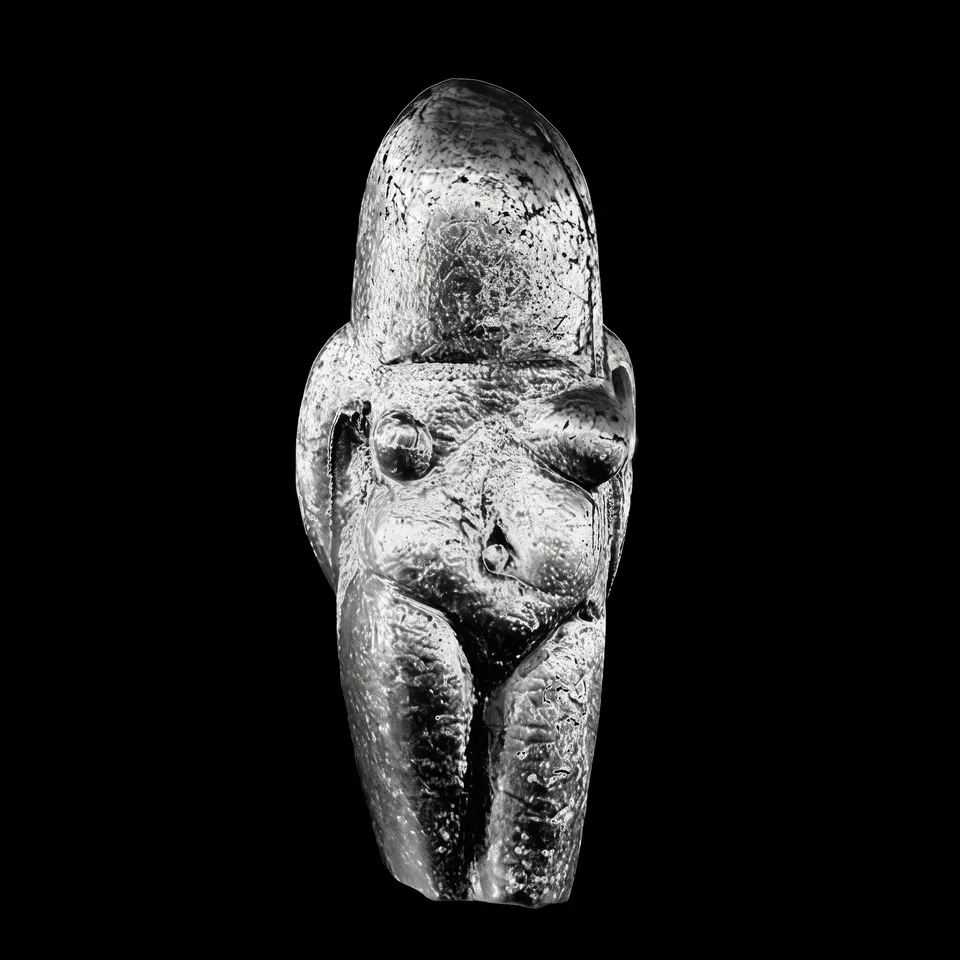
This stone goddess looks prehistoric. But she’s brand new. You might find her beautiful, or maybe strange.

Sculptor Hermine Bourdin is inspired by the appearance of goddess figurines in prehistoric times. Early examples of symbolic thought, their makers were continents apart. They knew nothing of each other. Yet the same powerful, exaggerated female form kept appearing, everywhere.

With archaeologists, Bourdin built a database of originals to compare their shapes, materials, and myths. She had AI models find patterns no eye could perceive. Then she carved this one in stone.

What else will we create, with insights from AI in mind?

Why is there a sculpture of a naked female in an exhibition about intelligence?

Because the figurines that inspired Bourdin to create The Idol of Kůlna mark a milestone in the evolution of human intelligence. Dating back tens of thousands of years, they are among the earliest known sculptures, and among the earliest to depict the human body. They are indisputable evidence of a mind making one thing stand for another – the aspect of intelligence that makes art and language possible.

Go deeper

Here’s the artist on Universal Venus, the project behind the sculpture, then an article about the prehistoric originals, and another on when humans began to think like us.

  • Artist’s website

    Universal Venus (opens in a new tab)
  • Encyclopaedia entry, Britannica

    The Venus of Willendorf (opens in a new tab)
  • Article, Smithsonian, 2012

    When did the human mind evolve to what it is today? (opens in a new tab)

Deviation Game

Tomo Kihara, Playfool (Daniel Coppen & Saki Maruyama)

Can you draw something that people recognise but an AI model doesn’t?

In 1950, codebreaker Alan Turing proposed the Imitation Game (aka the Turing Test). His idea? If a human couldn’t tell if they were talking to a hidden machine or person, the machine could be deemed intelligent.

Deviation Game flips the idea. To win, players must fool the machine by drawing something only their fellow human can interpret. Every winning doodle exposes a knowledge gap in the AI, a deviation from everything it’s seen before. After, you can delete your drawing or feed it to the game to help the AI evolve.

Will you pass as human?

Go deeper

Here are Deviation Game’s makers on why they built it, the 1950 idea it turns on its head, and an online game with the opposite goal, where you help an AI guess correctly.

  • Artists’ website

    Deviation Game (opens in a new tab)
  • Encyclopaedia entry, Britannica

    The Turing test (opens in a new tab)
  • Online game, Google

    Quick, Draw! (opens in a new tab)

5. Where’s all this heading?

Artificial general intelligence (AGI) would do every cognitive task our brains can do, at a speed and scale we never could. It isn’t here yet, so now’s the time to prepare.

The benefits to society could be huge. The risks, too. Governments and lawmakers are trying to keep up.

Sharing the gains of AGI, and dealing with its downsides, will require something like a new contract between citizens, governments and companies. What would you insist on?

The questions get deeper. Could an artificial intelligence ever be conscious? Would we even recognise that?

And who would we want to be, once machines can do the hardest thinking for us?

Go deeper

Here’s how lawmakers and governments are responding to advances in AI, what the public says it wants, and a neuroscientist’s answer to the question of whether an AI system can be conscious.

  • Article, Associated Press via PBS, 2024

    Europe’s world-first AI rules (opens in a new tab)

  • Survey summary, Ada Lovelace Institute and Alan Turing Institute, 2025

    How do people feel about AI? (opens in a new tab)

  • Opinion, The Guardian, 2026

    Why a chatbot that seems to think is probably not conscious (opens in a new tab)

Group chat

People have different hopes and fears about possible AI futures. Breakthrough medicines, clean-energy technologies, exciting new materials. But also displaced jobs, misused power, and questions around what thinking machines might do to our own thinking.

What do you think? Use the phone or keyboard to start a conversation with a sprite.

Go deeper

Here’s what people all over the world hope and fear about AI, one of the breakthroughs already happening, and an early look at what AI might be doing to our thinking.

  • Survey report, Pew Research Center, 2026

    Globally, more people expect AI to cause job loss than growth (opens in a new tab)
  • Article, MIT News, 2025

    AI designs antibiotics that kill drug-resistant bacteria (opens in a new tab)
  • Article, Google DeepMind, 2023

    Millions of new materials discovered with deep learning (opens in a new tab)
  • Article, Psychology Today, 2025

    How chatbots may affect your brain (opens in a new tab)

The Substitute

Alexandra Daisy Ginsberg

A northern white rhino manifests in an empty room, sharpening from a glitching mass into lifelike detail, over and over.

Artist Alexandra Daisy Ginsberg created this rhino, to explore our preoccupation with inventing new life forms rather than caring for existing ones.

Its movements and sounds are salvaged from footage of the subspecies’ final herd. Sudan, the last male, died in 2018. Only two females remain.

The rhino treads paths first travelled by a DeepMind AI agent. It explores its environment, learning the space as mammalian brains do. Watch it learn on the floor screen.

When its eyes find you, what will it see?

Go deeper

Here’s the artist Alexandra Daisy Ginsberg on why she created this artificial rhino, the DeepMind research that contributed to its explorations, and what happened to the last of the northern white rhinos.

  • Artist’s website, with video

    The Substitute, in the artist’s words (opens in a new tab)
  • Article, Google DeepMind, 2018

    How an AI learned to navigate like a mammal (opens in a new tab)
  • Article, Smithsonian Institution

    The Substitute in the Smithsonian’s collection (opens in a new tab)
  • Article, Ol Pejeta Conservancy, 2026

    What happened to the real northern white rhinos (opens in a new tab)

The Artificial, The General, The Intelligence

Mr Gee

Artificial general intelligence (AGI). Three words with lots to say. Performance poet Mr Gee has been listening.

He asked young people, and people building AGI, about their hopes and fears. The conversations inspired three poems.

The Artificial recognises our urge to create, and our complex relationship with technology.

The General explores the human need to feel significant in the face of increasingly capable systems.

The Intelligence questions how any intelligence should be assessed. By fulfilling tasks efficiently, or by bringing meaning to society?

What would you say about AGI, given a minute and a mic?

Go deeper

Here’s Mr Gee’s earlier poetry about data, what young people told researchers they want from AI, and a different poet’s answer to whether verse made by a machine counts.

  • Artist’s poems, with video, Open Data Institute

    Poems by Mr Gee (opens in a new tab)
  • Article, Alan Turing Institute, 2025

    Children’s views on AI (opens in a new tab)
  • Article, The Conversation, 2024

    People can’t tell the difference between human and AI-generated poetry (opens in a new tab)

Image credits

Artwork and image credits across AI.Exchange.